Saturday, 21 September 2019

Goodbye Caucasus Region!

Anne, Ramil and I leave Yerevan tomorrow morning on a 6 a.m. flight to Tbilisi where we meet Jeff, the owner of JMG Tibet Tours, and we all fly to Astana, Kazakhstan, to begin our tour of the 5 Stans.  We have enjoyed our time in Georgia and Armenia.   Here's what we've been doing:

We've been using different money in every country.  Turkey:  $1 = 5.74 lira; Azerbaijan:  $1 = 1.71 manat; Georgia:  $1 = 2.97 lari; Armenia: $1 = 475 dram.  Tomorrow we'll use Kazakhstan tenge at $1 = 387.7 tenge.  

Anne and I agree that the more you travel, the more you realize how little you know about history, geography, religion, governments, people.  And we know how lucky the USA is to have had normally peaceful, stable borders for 175 years.  We all should appreciate it.

9/14:  Along the road, we stop at Thea's favorite spot for sweet egg bread with raisins, which we call challah bread, made in tandoor ovens.  The recipe belonged to the Jews who used to live in this village.  Thea says the Jewish families left Georgia after the fall of the Soviet Union.  She says they were not persecuted in Georgia; I hope that was the case.  We travel to Vardzia and see the caves and stream in this beautiful canyon.  Continuing on to Akhaltsikhe, we see Rabati Fortress and museum.  Our hotel is inside the fortress.

9/15:  Returning to Tbilisi,  we visit the peaceful Borjomi national park and its town, where we taste two different mineral waters.  Pretty place.

9/16:  This is free day, and Anne is under the weather.   We read all day, and we later say thanks and goodbye to Thea.

9/17:  We are pleased that Kako is still our driver when we go to Armenia.   The crossing is pretty easy, and we meet our guide Karini.  Karini tells us Armenia is a small 30,000 sq km country now but prior to 1918, it used to be 10X its size.  The borders were from the Mediterranean Sea, to the Black Sea and to the Caspian Sea.  We had visited many former Armenian sites during our Eastern Turkey and Azerbaijan travels.  Armenia has been a Christian Armenian Apostolic country since 301 AD.  The temps are in the mid 80's.  Here, as well as in Azerbaijan and Georgia, we also see natural gas pipes running along the roadside.  They aren't below grade due to the rock that these countries sit on.  Armenia is not contemplating EU membership because of their close relationship to Russia.  We cross mountains near the Azerbaijan border, which has a history of trouble.  Armenia does have good relations with Georgia and Iran.  The alphabet has 39 characters and is lovely, different from the Georgian.  But like the Georgian, it is unreadable.  Trees in the forests are showing a little color change.  We visit the 10th C. Haghpat Monastery, which was damaged centuries ago by an earthquake.   It was restored in 2011 when Sultan Bin Mohammed Al Qasimi of Sharjah donated the funds.  We travel along the 353 sq mile Lake Sevan; and we learn that during Soviet times, the lake was dammed and drained, damaging the flora and fauna.  Later the lake was partially restored to a diminished size and quality.  We arrive in Yerevan.

9/18: This morning we see Mt. Ararat clearly from our hotel roof in the very nice city of Yerevan.  Our city tour shows us the Mother Armenia statue,  holding a sword indicating peace through strength, which replaced an earlier statue of Stalin which was removed in 1962.  We visit the Cascades Park and outdoor art museum, the history museum,  and then the haunting Genocide Museum.  It reminds us there is no limit to man's cruelty.  After 8 PM, Anne and I go to Fountain Square to see a fun water, colored lights and music display.  We dance and sing when they play Aretha Franklin's Respect.  We will see the show every night we're here, and we have previously gone out at night only once during this trip.

9/19:  Today we visit Khir Virap monastery.  In a little town, we see empty stork nests.  They've left for Africa already.  We learn of land near here that was given to Azerbaijan by the Moscow Agreement even though none of it touches the border of Azerbaijan.   Geez.  We travel through dry lands and again in fertile lands.  We see Noravanq monastery, and we decide to not visit the cave where the world's oldest shoe was found.  When the others return, we learn we missed meeting and a discussion with an anthropologist working that site.  Bummer.

9/20: We see the 77 AD Garni Pagan Temple site at a gorge, dedicated to the god Mitra.  It also has a royal residence and bath with Roman tiles.  It was damaged by an earthquake in the 1700's and restored in the mid 1900's by the Soviets.  We pass a town of abandoned homes damaged in a recent earthquake.  We see the 12th C. Geghard monastery.

9/21:  Today is the 28th Armenian Independence Day since their split from the Soviet Union in 1991.  Best wishes to them!   We visit the Armenian Vatican, Echmiadzin Cathedral, and its museum, where we see a room dedicated to the Manoogian family from Michigan.  The family fled the genocide,  created a successful faucet and auto parts business, and made big donations here.  We even see a picture of Detroit's Manoogian Mansion on the Detroit River, the official residence of Detroit mayors.  We visit the ruins of Zvarots cathedral built on the site of the ruins of a pagan temple.  This afternoon there is a short but loud parade celebration in front of our hotel.  We say thanks and goodbye to Karini.  We thank Kako for driving us safely through Georgia and Armenia;  we wish him safe travels back to Georgia.   Tomorrow,  the 5 Stans!!


Sunday, 15 September 2019

Green Monastery & Borjomi photos

Beautiful green forested road to the Green Monastery


 Kako, our great driver, and our transport vehicle

Beautiful flowers at the Monastery

Awesome colors

Borjomi, spa town, noted for its mineral water


Vardzia Caves & Akhaltsikhe Photos

Vardzia Caves were once completely enclosed and used by the people to live in when threatened by enemies
 Construction was the second half of the 12th century
 Frescos in the Dormition Church in 

The slots in this room is believed to be part of the pharmacy 


View from the top of Erusheti Mountain on the left bank of the Kura River

It was fun walking thru all the passages

 Walking down out of the caves

Our group, Dale, Eunice, Jan, Anne, Maddy, Steve & Fran 

Thea, our Georgian guide

Rabati Castle is a fortress in Akhaltsikhe built in 9th century.  It is now a museum, hotel, and great locale for special events 

View from the fortress 

Our view from our sitting area outside of our hotel in the fortress 


Saturday, 14 September 2019

Gori, Gelati & Kutaisi photos

We went to Gori and visited a museum where there were pictures and information about Joseph Stalin because he was born in Gori, Georgia 
He was a tyrant!  Starving Ukrainian and Russian people to push his agenda for a communist government.

Gelati Monastery built by King David of Georgia during it’s Golden Age


Monastery was on the UNESCO World Heritage site, but now must change the roof tiles to conform to the original style - this has the original tiles

Tiles that must be replaced

View from the monastery not far from the city of Kutaisi

 View of Kutaisi from the centuries old Bagrati Cathedral

View from our hotel in Kutaisi and the Rioni River  


Friday, 13 September 2019

Greetings from Bzholebi, Georgia!

This morning  we left Tbilisi and the very nice Tiflis Palace Hotel, heading west and north into the mountains.   Our first stop was at the Stalin museum in Gori, where he grew up.  We learn that he was very handsome as a young man, and his friends gave him the name Stalin, meaning man of steel.  We viewed many pictures and personal objects while we toured the museum, his boyhood home and the train car he traveled in (he was afraid to fly).  We drive up into the mountains to Kutaisi to see a(nother) monastery and cathedral.   Our lunch meals usually include bread, cheese bread, cheese, fried potatoes and onions,  tomatoes and cukes, pork and often chicken.  Today we also had spinach with crushed walnuts,  eggplant with crushed walnuts,  fish, beans and bean bread.  There are seven of us tourists,  two guides and one driver.  Lots of food remains on the table at the end of the meal.   Tonight we have clear skies and see the beautiful full moon.  Since I last wrote to you:

9/5:  We fly from Gaziantep to Istanbul,  then on to Baku, Azerbaijan, the start of our tour of the southern Caucasus with JMG Tibet Tours.   We are met at the airport by Aydin, the tour company owner, and Ramil from Kyrgyzstan who will  be our guide through 5 countries.  On our way to the hotel, we see brightly lit buildings and drive on some of the roads used earlier this year as the track for the Formula One races.  We learn that Azerbaijan is a secular country, but Muslim nevertheless. 

9/6:  We meet our fellow tourists,  all from the USA (Jan & Dale, Steve, sisters Fran & Eunice ).  Our local guide, Jamil, tells us that the country was formed in 1991, following  the collapse of the Soviet Union. We tour the city and see the 12th C Maiden Tower, originally a Zoroastrian site.  We see the Aisle of Martyrs and memorial flame, a miniature book museum, the 3 Flame Towers, and a carpet museum built in the shape of a partially-rolled up carpet.  We give the guys the nicknames of Rams and Jams.

9/7:  As we drive along the Caspian Sea (which is really a lake), we see oil fields along the coast.  We visit the Zoroastrian fire temple and a cemetery of famous people.   Jamil has strong feelings against the Armenians.  Guides don't usually express their own opinions, and it affects my opinion of him.

9/8:  From Baku, we drive along a gorge to Lahic, an old coppersmith town.  Today is the first time we wear long sleeves.  Anne walks across a suspension bridge.  Aydan gives us a great treat by stopping along the roadside to buy bread freshly baked by a refugee woman from Turkey in her tandoor oven.

9/9:  We continue on to Sheki in the mountains  and visit a nice bazaar.  We see an ancient temple of the Caucasian Albanians (not the current-day Albanians).  In Kis, a former Christian village, I saw my first persimmon tree and a beautiful cockscomb plant (my photographer got a great picture).   We see lovely Sheki Palace.

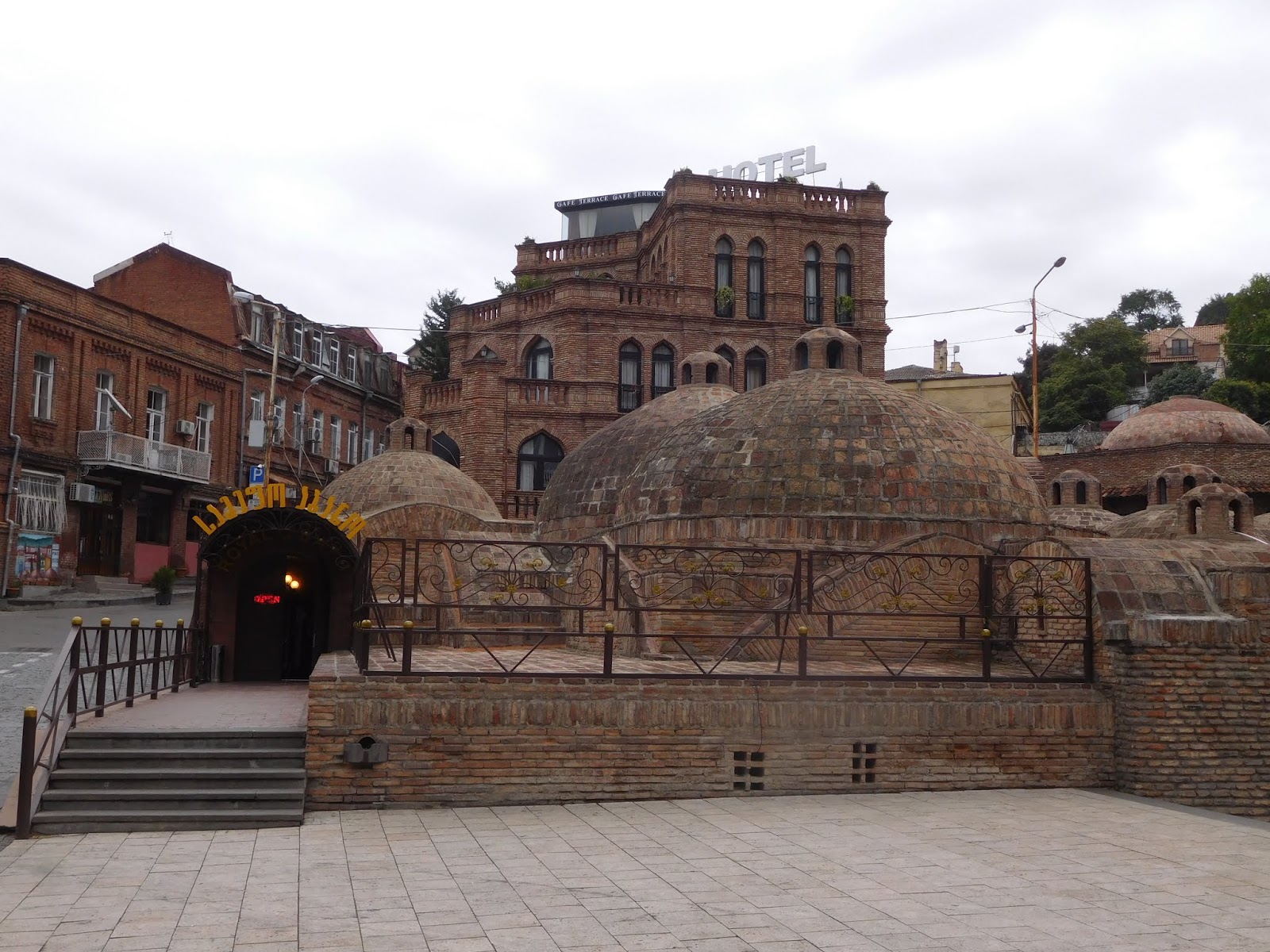
9/10:  This morning we are driving to the border with Georgia.  We pass huge washes;  there must be big snow melts and rains.   We say thank you and goodbye to gracious Aydan, Jamil and Azerbaijan.  Our bus driver takes us near to the border where our luggage goes through xray machines.  We drag our luggage about 300' and go through passport control.  We meet Thea, our local guide, and Kako the bus driver.  Georgia is not yet a EU member, but they are expecting to be soon.  The license plates and coin dollars already resemble those of the EU.  We continue to see sheep and cattle herds, and we are surrounded by the Caucus mountains.   The Georgian alphabet is beautiful, but it is totally unreadable!  This is an Orthodox country but very welcoming to all.  On our way to Tbilisi, we drive through a huge wine-making region.  Thea says it's the earliest wine region, but we were also told that in Slovenia.   Tbilisi is 105+/- miles from Russia.  We see most homes and apartments with balconies.  Our room at the Tiflis Palace hotel faces the main street, but in between there are below-ground thermal bathhouses (we are in the bathhouse district).  Beyond the road is the Mtkvari river, and there's more of the city on the far side.  We do smell mild sulphur from the bathhouses. This city is a big playground with casinos and slot machines, river rides, a funicular up a mountainside;  it's delightful.  It's gorgeous all lit up st night.  We were served pork for the first time in weeks, and there were 3 different wines to try with lunch.  We also had the opportunity to try Chacha, a grape vodka.

9/11:  Again, we reflect on this somber day.  We walk through the old city, ride the funicular, visit the Mother Georgia statue.  As everywhere, there are cobblestone roads and sidewalks and difficult tall steps.  Traffic patterns on the roads are wild with almost no traffic signals,  just circles.  Dogs in the city are looked after by some group.  They are tagged, vaccinated and sterilized.  We see Soviet-era buildings.  I notice we are seeing paisley prints everywhere. 

9/12:  We drive the Military Road (65 miles to Russia) north into taller Caucasus to visit monasteries on lovely hilltops.  There are waves and waves of pilgrims to these sites.  Ramil promises he won't take us to any monasteries in Kazakhstan or Kyrgyzstan ( just plenty of mosques).  Anne, Ramil and I go to Prospero's book store, where we buy a couple books and enjoy libations in their cozy patio.

Anaruni Fortress, Jvari Monastery Photos


 Zhinvali Reservoir on our way to the Anaruni Fortress on the Georgian Military Highway along the Caucasus Mountains - historic name for the major route from Georgia to Russia. It runs between Tbilisi in Georgia and Vladikavkaz in Russia

 Anaruni Fortress - castle complex on the Aragvi River about 45 miles from Tbilisi
.

Beautiful location for the fortress


Interesting area to roam around and view the ruins

Jvari Monestary, translated as the Monestary of the Cross,  604 AD,  located on the hill top near the town of Mtskheta - early Orthodox architecture 


UNESCO Site 

Monestary overlooks the old and new sections of Mtskheta 

View from the monestary where the Mtkvari River (Kura) & Aragvi River meet 

A neat bookstore & cafe in Tbilisi that  Maddy read about that is frequented by expats 


Wednesday, 11 September 2019

Tbilisi Photos - Capital of Georgia

View from our room in the Tiflis Palace 

Balcony in our room

Some thermal baths right next to our hotel

Tbilisi is a multi-ethnic, multi-cultural, multi-religious city

 Tbilisi sits on sulphuric water & thermal springs (located under the Narikala Fortress)


Nice walking path near homes and to a waterfall

Falls in the old city 


 Homes in the old city


And of course.....


Walking thru the streets of the city

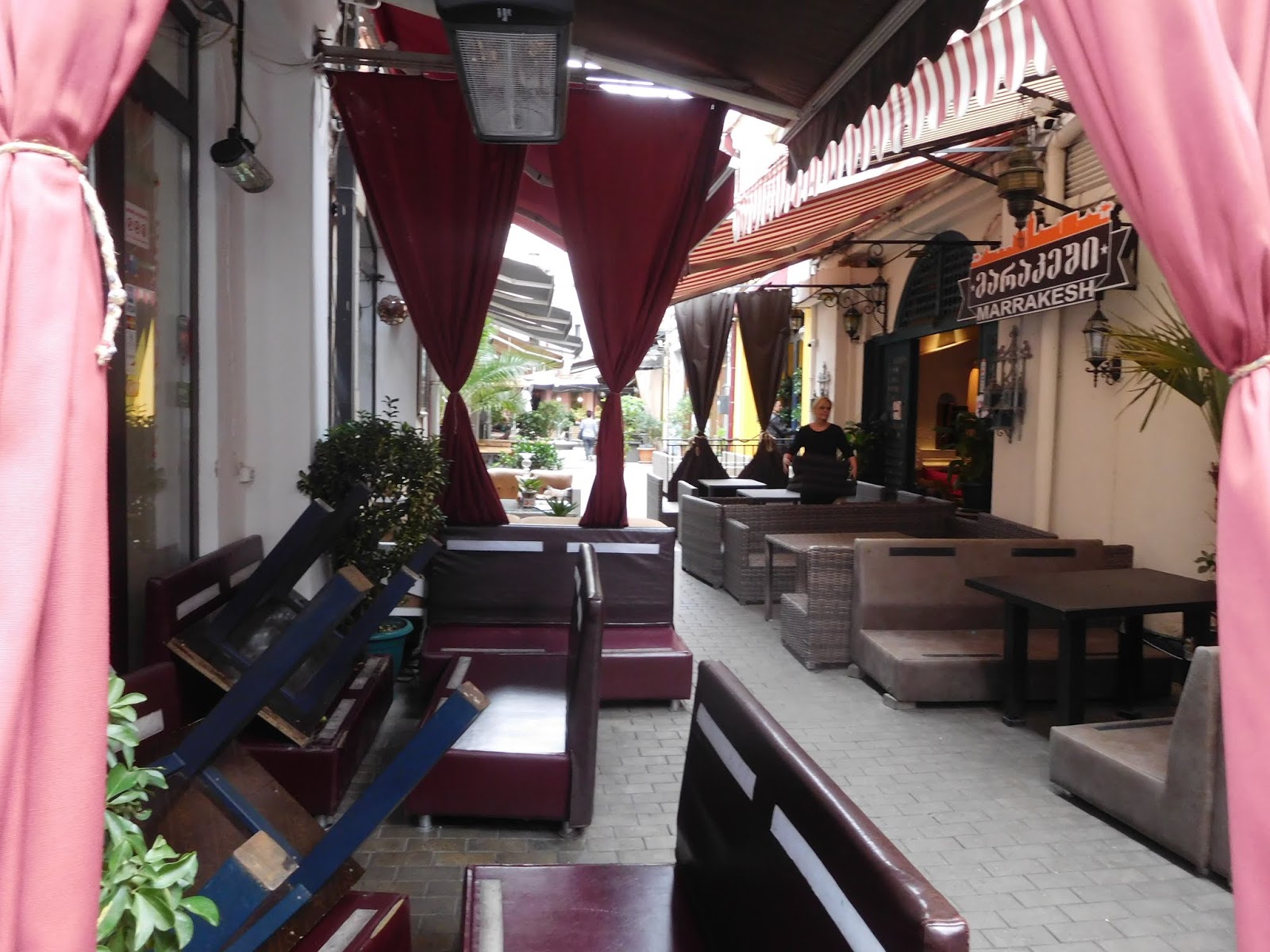
Lots of cafes to enjoy


Entrance to the old bazaar

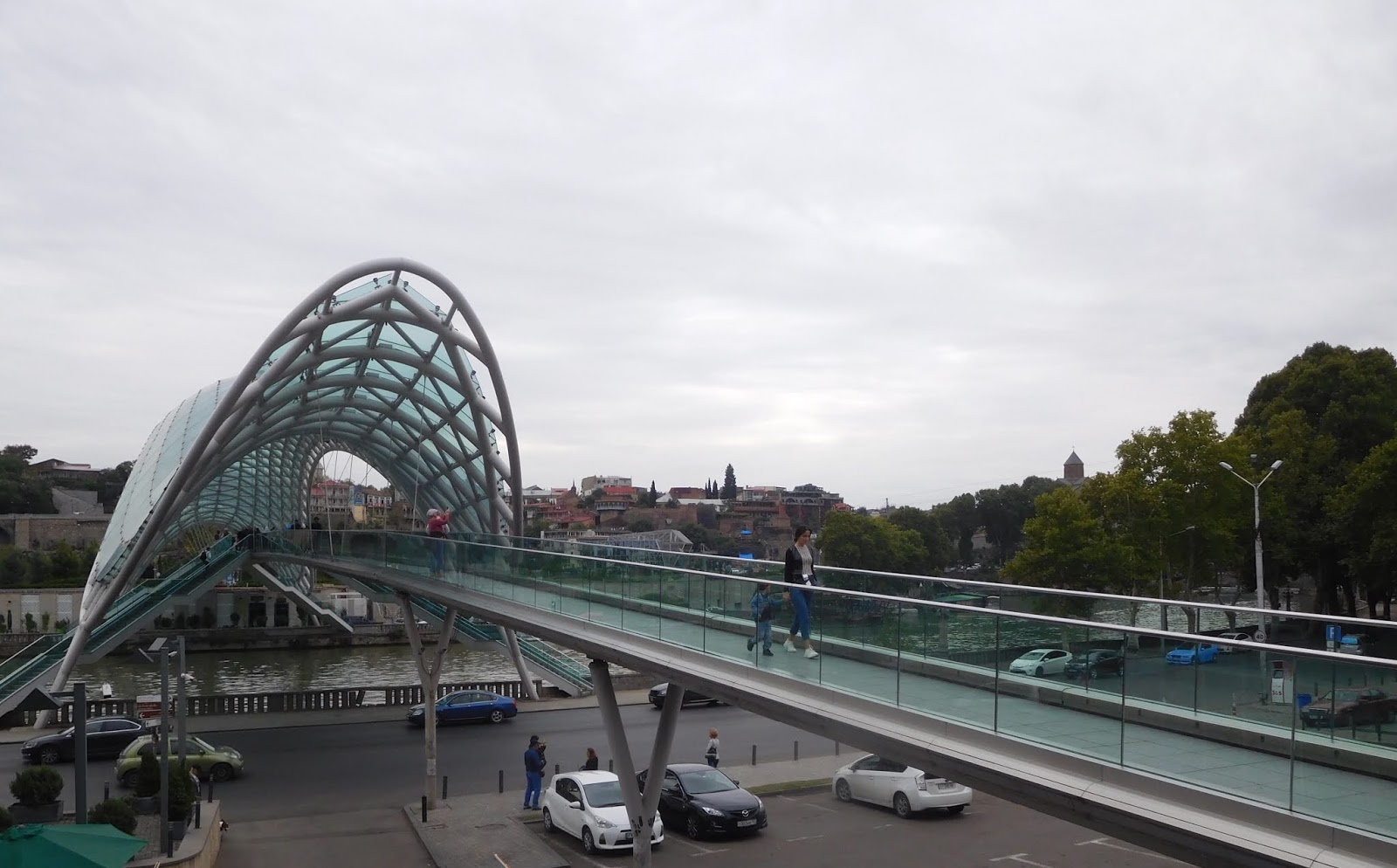
Peace Bridge over the Kura River connecting Old Tbilisi with the new district


Kura River with Peace Bridge in the background

Kura River

4th century ruins of Narikala Fortress

We took a funicular to the top of the hill to view the city 

Kartlis Deda, Mother Georgia, holding a cup of wine for friends and a sword to protect from enemies. Statue is 66 foot tall & made of aluminum


National Cathedral of Georgia